
Previous FONT Birding Tour Highlights
From June 2001 back to Sept 2000
(With the most-recent
first, then going back in time. Click link to tours you find of interest.)
(IN THE SUMMARIES, THERE ARE LINKS TO UPCOMING TOUR ITINERARIES &
BIRD-LISTS)
North Carolina USA pelagic trip June 10, 2001
Delaware USA pelagic trip June 9, 2001
Hungary, Romania, Slovakia - May 2001
Colorado USA "Grouse
Tour" - April 2001
Japan
- April 2001
Caribbean
-- February-March 2001
(Dominican Republic, Puerto
Rico, Cayman Islands, Jamaica)
Japan -- January-February 2001
New
Zealand - November-December 2000
Chile - November 2000
Pacific Coast USA & Canada - September 2000
North
Carolina USA pelagic trip June 10, 2001
Delaware
USA pelagic trip June 9, 2001
A South Polar Skua that
flew in toward the boat stayed with it for about half an hour. It was so close
that it filled photographer's frames - sometimes so close that all of the wings
were not in view. (A photo or two will be here soon.)
The skua seemed as if it might even land onboard the boat. It also kept occupied
by chasing neaby gulls and storm-petrels.
According to trip leader, Andy Ednie, this South Polar Skua was "the 3rd in
4 Delaware FONT pelagic trips".
Seabirds, in addition to the skua, included: both Leach's and Wilson's
Storm-Petrels; Sooty, Cory's, and Greater Shearwaters, and a Pomarine
Jaeger.
A total of 9 Finback Whales were seen. They put on quite a show, blowing
and rolling on their backs on the surface of the water. This was as Common
Dolphins were riding the bow. The count of dolphins was 30. Four Loggerhead
Sea Turtles were also seen.
Alaska
May-June 2001
Other notable birds during the Alaska tour included:
both male and female Steller's Eiders, a fly-by female Spectacled Eider, a flock of 6 Bramblings, and Wood Sandpipers doing flight displays (on St. Paul Island), both Olive-backed and Red-throated Pipits the same day, both Three-toed and Black-backed Woodpeckers, and Ivory Gulls at Nome - as many as 3: an adult, an immature, and a 1st-summer bird.
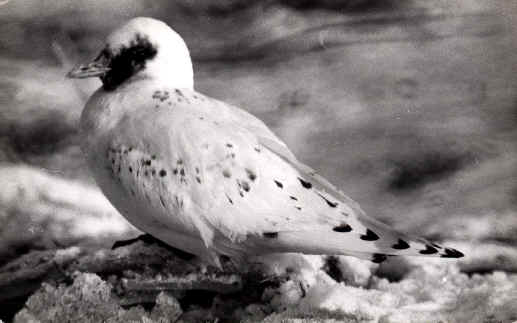
Ivory Gull (immature)
3 Ivory Gulls were seen during the FONT Alaska Tour
in May/June 2001: a bird such as this, an adult, and a 1st-summer bird.
All seen closely and well, near Nome.
(Photo by Alan Brady)
On the Pribilofs during
our FONT
tour, in addition to the Asian strays, birds that were enjoyed included:
singing Snow Buntings and Lapland Longspurs, and the colonies of alcids, Red-legged Kittiwakes, and
Red-faced Cormorants. And, oh
yes, the nesting Rock Sandpipers.
The "top ten" birds as voted by participants after the tour were:
1 - Ivory
Gull
2 - Far Eastern Curlew
3 - Steller's Eider
4 - Willow Ptarmigan
5 - Boreal Owl
6 - Brambling
7 - Pacific Loon
8 - Red-throated Pipit
9 - Harlequin Duck
10 - Crested Auklet
During one day, near Nome, over 100 ptarmigans were seen, mostly but not
all males in breeding plumage - both Willow and Rock.
During the tour, nearly 40 Moose were seen.
Alaska is, of course, a BIG place. So there's more to a tour there than the
birds and animals we saw as we traveled through the tundra and taiga. There was
stunning scenery, particularly with the mountains, including Mt McKinley, which
we saw nicely on a clear day.
Cumulative list of
birds & mammals found during FONT Alaska tours
Birds seen in the
Pribilofs (St. Paul Island) during FONT tours
Some photographs of birds that have been seen in Alaska as Asian vagrants can be
viewed in the Photo
Gallery of Japanese Birds & Other Wildlife.
Hungary,
Romania, & Slovakia
May 2001
Our first FONT birding tour in Hungary, and adjacent Transylvania (in Romania), and Slovakia May 5-17 2001, was tremendous. It sold-out early, and we expect it will to do so again in 2002. It was led in 2001 by the expert Hungarian birder, Janos Olah, Jr., and Armas Hill of FONT.
The following account, written by Armas Hill, gives some of the numerous highlights of the tour:
Transylvania is a place that not many from North America (or elsewhere for that matter) visit. Maybe some are not sure where it even is. It's a beautiful area, with rolling green hills, with fields and forests, in northern Romania. It's inhabited by Hungarians, and others, who live in a countryside much as it was years ago. They hoe in farm fields much as generations did before them. On the roads, there are often more horse-drawn carts than automobiles. In one small city, there's a sign at a McDonald's even advertising a burger called the "McRustic" (no, we didn't eat there).
In addition to being beautiful, the Transylvanian countryside is wild. We spent 3 nights in comfortable lodging at the edge of extensive woods, in which there are wolves and lynx, boars and bears. Late one afternoon, our group split into 3 smaller parties (of 4 people each), going into hides, awaiting and then watching, closely, large Brown Bears come into clearings in the forest. These huge animals being much like the Grizzlies of the American West. It's said there are 6,000 bears in Transylvania. We also saw Red Deer (much like Elk in North America) and Red Fox.
And we saw birds - among them, Capercaillies in the Transylvanian forest - 2 of them, taking a dust bath on the side of a dirt road, just outside the windows of our bus. Also in the coniferous forest, Spotted Nutcrackers and Crossbills were seen on treetops. Sounds included the beautiful notes of the Ring Ouzel and the hoarse croaks of the Raven.
In a rocky gorge in Transylvania, there were not only White-throated Dippers at their nest, but 2 pairs of courting Wallcreepers were seen flitting on the cliff-sides above us.
At the castle grounds of Dracula, a figure of the Transylvanian past, birds present for us included Redstart and Robin.
But only part of our tour has been
in Transylvania. Also we've been in the Great Hungarian Grasslands, where birds
have included:
Storks on nests in the towns and villages,
Cranes in the fields,
Herons and Egrets, Spoonbills and Ibises in the marshes.
Bitterns (both Great and Little) heard or seen in the reeds.
Cormorants (both Great and Pygmy) seen at their colonies.
Among the waterfowl, there were Ferruginous Ducks and Garganey.And all 3 "marsh Terns" were seen together - the Black, White-winged, and Whiskered. (Reminding those of us from Delaware of the one time that ever happened in North America).
Other birds of the open Hungarian countryside ranged from the huge Great Bustards to the contrastingly diminutive singing Bluethroats and the rare Aquatic Warbler. By the water's edge, there were Bearded Reedlings and Penduline Tits. On a mudflat, a brightly-plumaged Red-throated Pipit landed tamely by us.
In all, we saw
23 species of shorebirds. Among them, there were Ruffs in an assortment of
colors chestnut, black, white, tan, and various combinations - with feathers in
an array as the birds would display. In all, there were hundreds of Ruffs and
Reeves. Other shorebirds included Spotted Redshanks, Curlew Sandpipers, and a
Marsh Sandpiper in breeding plumage, Temminck's Stints, Black-tailed Godwits,
Curlews, and Avocets.
But foremost was a species that's normally in Asia, a White-tailed Plover - a
bird that's been spreading west. The first breeding of the species in Europe was
in 2000, in the Danube Delta of Romania. Prior to 1999, there were only 4
records (ever) in Hungary. Since then, there have been about that many per year.
Our bird in Hungary in 2001 was the first found there this year. (The species
was seen previously during a FONT European birding tour - in the late 1990's in
Bulgaria.)
Outside the lodge where we stayed in Hungary, Nightingales and Cuckoos sang and called through the night. Early in the morning, there was the beautiful sound of the Golden Oriole, which was seen beautifully, later in the morning sunlight. 2 Black Woodpeckers were territorial just outside our windows.
Among our
raptors in the nearby Hungarian countryside were both Montagu's and Western
Marsh Harriers, Long-legged Buzzards, and Red-footed Falcons - the latter in
flocks seen feeding on insects low over fields, both the males and females with
their distinctive plumages.
A Steppe Eagle was seen well overhead. The species is a rarity in Europe west of
Russia. The last seen in Hungary, prior to our bird, was in 1998.
Among other raptors seen was the Saker, the largest of the world's falcons after
the Gyr, and a bird depicted on Hungarian coinage,
- and one of over 200 different birds seen during our Hungarian FONT Tour in
2001. Others included: Corncrakes (seen well), owls (seen well): Ural, Tawny,
and Eagle.
Eagles themselves, included: Imperial, Lesser Spotted, Short-toed.
List of Birds & Mammals during May 2001 Hungary Tour.
"Top Birds" as voted by participants at tour's end, May 2001.
Colorado USA Tour for Grouse and other Birds
April 2001
The following account written by the FONT tour leader, Art McMorris:
We all enjoyed
our April 2001 tour of Colorado and nearby southwestern Kansas in search of
grouse (7 species) and other regional specialties. 2001 was the second year for
this FONT tour. Both were very successful and enjoyable.
Our aim was to find grouse during their spring lekking displays: Greater and
Lesser Prairie Chickens, Greater and Gunnison Sage Grouse, Sharp-tailed Grouse,
Blue Grouse (which display but do not lek), and White-tailed Ptarmigan (which do
not display). Lesser Prairie Chickens and Gunnison Sage Grouse are among the
rarer North American birds, and White-tailed Ptarmigan can be among the harder
to find. We found and had excellent views of all our avian target, and nearly
all of the "bonus birds" we had hoped for, as well. Our final tour
count was 168 species, 175 birds including subspecies. We also saw a good
variety of mammals.
During our first full day of
birding, one of the first birds we found was a Mountain Plover (a threatened
species rather related to dotterels). It was the ABA bird #650 for one of our
tour participants. (Another participant topped 700 later in the tour). Also on
day one we observed both Clark's and Western Grebes, and a good assortment of
other waterbirds and shorebirds, including avocets and White
Pelicans. Later, a
brilliant male Vermilion Flycatcher, a flock of Evening Grosbeaks, and Pine Siskins. Among the species in southeastern Colorado canyons were: Canyon Towhee,
Rock Wren, Ash-throated Flycatcher, and Black-chinned Hummingbird.
The short-grass prairie in adjacent Kansas produced: Scaled Quail, Swainson's
Hawk, Golden Eagle, Prairie Falcon, Long-billed Curlew, Eurasian Collared-Dove,
Lark Bunting, and about a hundred Chihuahuan Ravens.
Day two started at dawn with a
visit to the Lesser Prairie Chicken lek. Ten males and one female came to the
lek, and we watched the males puff up their purple air sacs, boom, dance and
display for nearly an hour before breakfast (for us). The current population of
Lesser Prairie Chickens is estimated at only about 2,000 birds. After our
breakfast we headed for sewage ponds, making it a "real birding tour".
We saw both the "Audubon's" and the "Myrtle" Yellow-rumped
Warblers, before heading north to the tall-grass prairie of northeastern
Colorado, the home of the Greater Prairie Chicken. Along the way, and in a
gathering storm (wind and rain turning to snow), we saw many Swainson's Hawks
(both light and dark morphs), Ferruginous Hawk, and Pronghorn
Antelope.
The next day we would be seeing lekking Greater Prairie Chickens on private
property. Visiting the home of our kind hosts, this evening, we were treated to
a presentation on dinosaurs! We were shown a Triceratops skull that had been
excavated on ranchland in South Dakota, and had been assembled from hundreds
(thousands?) of fragments, and we were given a vivid description of life in
North America during the late Cretaceous period, 70 million years ago.
The next morning (day three) we
were on the lek just after 5am for close-up views of Greater Prairie
Chickens.
Approximately 40 birds were present (2 females, the rest males). The red-rimmed
yellow air sacs and the lower-pitched "booming" of the males was quite
distinct from that of the Lesser Prairie Chicken. It was amusing to observe the
contrast between the ardor of the males and the seeming indifference of the
females! During the afternoon this day, in grasslands, we saw both McCown's and
Chestnut-collared Longspurs.
On day four we headed west into the Rocky Mountains to search for White-tailed
Ptarmigan in their exquisite snow-white winter plumage. And we found four of
them, quite close to the road. We enjoyed leisurely looks, and then turned to
see the stunning scenery at the pass on the Continental Divide. As we descended
the mountain, we enjoyed foraging Dippers in a stream. As "dessert for the
day", at a feeder, we observed 5 different subspecies of Dark-eyed
Juncos,
as well as the Rocky Mountain "Slate-colored" race of the Fox
Sparrow.
During the morning of day five there were more mountain birds, starting with
small friendly group of Gray Jays, and then all of the Rosy Finches: Gray-crowned (both the
nominate and "Hepburns"), Brown-capped,
and Black. Also there were Pine Grosbeaks, Cassin's Finches, and
more juncos.
At a reservoir, during the middle of the day, both Barrow's and Common
Goldeneye were seen.
Mountain Bluebirds were seen long the road we traveled north into Sage
Country.
Bird-wise, this was a "three sage day" for us, with, first, Sage
Thrasher being seen. Then, in the evening, we went to the site of a Greater
Sage Grouse lek, where, at the appropriate time, the birds appeared and
displayed until dark. There were 47 males and 4 females. Also in the area of the
lek there were 4 species of raptors: Swainson's Hawk, Ferruginous
Hawk, Golden Eagle, and American Kestrel. And there was the third of
the species entitled "Sage", the Sparrow.
Day six began with a visit to a reservoir where there were all three teal
(Green-winged, Blue-winged, and Cinnamon), four members of the
genus Aythya (Canvasback, Redhead, Ring-necked Duck, and Lesser
Scaup), plus other waterfowl and shorebirds.
In a nearby alpine-meadow area, we found Rough-legged Hawk and displaying Common Snipe, and in aspen and coniferous forests there were
Red-naped
and Williamson's Sapsuckers and Red Crossbills. At the forest
edges, there were 4 Moose.
After driving further west, a final birding stop this day produced Sandhill
Cranes, Marbled Godwit, and many Wilson's Phalaropes.
The morning of day seven was a "three grouse morning" for us. First,
after a few minutes of looking and listening, we found a single Blue Grouse,
then another, and four in all - two males and two females. A female being
actively pursued by one of the males took flight - and came directly over our
heads, so close we could feel the rush of the wingbeats - and then it landed
just beyond us. The male followed immediately, flew over our heads, landed, and
kept right on displaying. After 20 minutes or so of watching, we tore ourselves
away and headed down the road to a Sharp-tailed Grouse lek, where we
watched 12 males eagerly doing their wind-up-toy display before 3 females -
wings outspread, tails cocked, head bowed, rapidly stamping their feet. Then, a
bit further down the road, we watched 5 Greater Sage Grouse display,
while Sandhill Cranes bugled overhead and landed on a hillside near a
herd of 20 to 30 Elk.
We then did our long drive toward Gunnison, with a few birding stops on the
Grand Mesa where, in the arid lower canyon, we found: White-throated Swift,
Canyon Wren, Rock Wren, Black-throated Gray Warbler, and Say's Phoebe.
Higher up, amid snow, there were Gray and Steller's Jays and Clark's
Nutcrackers.
Closer to Gunnison, in the open country, before the day's end, there were Coyote
and Badger, Horned Larks, Vesper Sparrows, and
beautifully-singing Western Meadowlarks.
Our last birding day began with us, at dawn, at the lek of the Gunnison Sage Grouse. There were 30 displaying males and 2 females. This bird was only recently recognized as a species distinct from the Greater Sage Grouse, and only about 4,000 are believed to exist. The birds arrived about 20 minutes after first light, diplayed for an hour, and then all flew away at once. That was our cue to go away for breakfast, before heading east toward the airport. At a stop along the way, we found two loose groups of Pinyon Jays - completing our sweep of Colorado Corvids (10 species in all). and yet another nice bird was to be seen this day, the Lewis' Woodpecker. We saw 4 of them, with their stunning green, white and rose in the afternoon sunlight. As the day ended, so did our fine birding tour in Colorado and Western Kansas, USA.
This tour is scheduled for 2002,
again with Art McMorris as the leader. 3 people have already registered. The
April 19-28, 2002 tour itinerary is in the web-site.
Bird-lists (cumulative and for
2001) are also in the site.
Visit our North American Bird Photo
Gallery for photographs of Blue Grouse, Greater Prairie Chicken, and
White-tailed Ptarmigan during the April 2000 tour.
Japan
Spring Birding Tour
April 2001
(Including a little island with a big fallout of migrating birds)
Our early spring birding tour in
Japan
in 2001 was one of
the most enjoyable FONT tours ever done. With fine spring weather, and lots of
trees in colorful blossom, there were some wonderful birds that fit well into
the setting. Among them:
colorful Mandarin Ducks, in small flocks, floating on still ponds,
Japanese Murrelets on the sea, along with hundreds & hundreds of Streaked
Shearwaters,
male Copper Pheasants, early in the morning, displaying close at hand in
the forest (they drum their wings as a Ruffed Grouse does its tail),
also flocks of migrants from shorebirds (including Great Knot, Far
Eastern Curlew, and Mongolian Plovers) to buntings and
finches (a lingerer was a Pallas', or Siberian, Rosefinch).
Signs of spring were Japanese Reed Buntings singing on territories and
the rare Japanese Marsh Warbler doing its display flight.
But the highlight of the tour was a visit to a small island (only 1 kilometer by 2 kilometers) in the Sea of Japan where there was a tremendous fallout of northbound migrants. The island called Hegurajima, about 50 kilometers offshore, reached by boat. We overnighted on the island in an inn - one of very few buildings. One could easily walk the circumference of the island in just over an hour. The few residents there earn a living by fishing and collecting seaweed. It's such a picturesque place, with a tall white lighthouse, and no automobiles. Just small lanes and paths. But, oh my, were there birds!
As we walked from the boat dock to the inn, between small buildings and in the brush, birds abounded. Many of them: Siberian Stonechats, Red-flanked Bluetails, Daurian Redstarts, Dusky Thrushes, Bramblings, Rustic Buntings, and Eurasian Siskins. But others too. Among the 70 or so species found on the small island: Japanese Robins, Siberian Rubythroat, White's Ground Thrush, Hoopoes, Eastern Crowned Warblers and Sikhalin Leaf Warblers just to name a few. There are no tall trees so birds that can be hard to see at other places were not on Hegurajima. Vagrants for Japan were Black Redstart and Greater Short-toed Lark.
Our April 2001 tour was the 12th FONT
birding tour in Japan.
Over the years, our Japanese Winter Birding Tours have been very popular (understandably with
cranes, eagles, Blakiston's Fish-Owl and
more). During the winter tours, the length of Japan is covered, from Hokkaido to
Okinawa. A nice feature of our Spring tour is less travel - we're only on Honshu, with migrant birds coming,
actually, to US in
various habitats.
Itineraries for FONT Japan birding tours
in 2002 & 2003 are now in our web-site, for the Winter and the Spring tours.
FONT birding tours in Japan have been led by Armas Hill, with the aid of various
local birding contacts throughout the country. Armas has birded in Japan
extensively since 1984.
Costa Rica Birding Tour
March 2001
Again, in March 2001, we did a birding tour in one of our favorite destinations, Costa Rica. That tour was our 23rd birding tour in that country.
As always, there were highlights (with Costa Rica, how can there not be? - where toucans & trogons, oropendolas & orioles, and other colorful birds of the tropics are common).
In addition to those birds:
To be especially remembered were the "wake-up calls" about 5 o'clock two consecutive mornings, given by the Gray (formerly called the Common) Potoo outside our windows. Surely the sound is one of the most beautiful in the natural world. And it was a nice experience indeed to lie in bed and hear that melodic sound, in the dark, just prior to the explosive dawn chorus of other birds - in the tropical rainforest in the Caribbean lowlands at Laguna del Lagarto.
Later during the day, from the edge of one of the small lagunas there, we enjoyed the sight of a Sungrebe swimming along the opposite shore. The previous day, another good sight was of a Striped Owl looking at us, from a tree, by the edge of the road, on our way to Laguna del Lagarto.
In forested slopes, by other roads, earlier in the day, our birds ranged from the Barred Becard (not often seen as well as it was this time) to colorful tanagers and warblers. Among the latter, one deserving mention was the dapper Collared Redstart. And there were a number of hummingbirds (at a place we visited with feeders) - among them the Green Thorntail, Violet Sabrewing, and the Coppery-headed Emerald (the latter one of the few birds endemic to Costa Rica). All of the hummingbirds were great to watch.
But a particular highlight during the tour, in addition to the birds that we've mentioned, was certainly the pair of Great Green Macaws in a tree above us, almost oblivious to our presence. This magnificent species, the 2nd largest of the New World Psittacine, is one of the rarest of Neotropical birds, having a limited distribution in wet lowlands from eastern Honduras to western Colombia, with a very small isolated population (of less than 2 dozen birds) in western Ecuador.
In Costa Rica, it's been estimated that there are fewer than 35 pairs of Great Green Macaws breeding annually. It was really a wonderful experience for us to spend some time with one of those pairs.
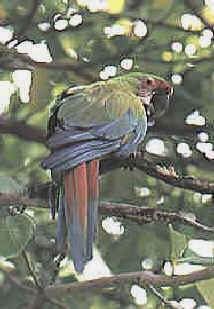
Great Green Macaw
(Photo courtesy of Kurt Schmack)
Photographs taken during previous FONT birding tours in Costa Rica can be found in this web-site in the Photo Gallery of Birds of Central and South America.
Upcoming Costa Rica birding tours.
Caribbean Birding Tours
February-March 2001
Dominican Republic
Puerto Rico
Cayman Islands
Jamaica
Again, in 2001, we had some very good birding during FONT tours in the Caribbean.
Just imagine - in the West Indies, sitting by a pool of water high in the pine-clad mountains of the
Dominican Republic, and watching about a dozen Hispaniolan White-winged Crossbills drinking at the waters edge. And with them, some colorful Andean Siskins.One day earlier, from a boat floating quietly on a nearby lake, imagine being surrounded by pink flamingos walking at times, in unison, and even-pinker Roseate Spoonbills moving their bills back-and-forth in the water as they fed, in the distance, endemic White-necked Crows were going to their evening roost in the palms.
The day before that, two species of todies, both of them bright and perky, were seen from along the same road - one in dry lowland shrub, the other in highland forest. Somewhere in between, along that road, there were in one tree, parrots, parakeets, and trogons.
Also during the
Dominican Republic tour there were birds such as tiny Vervain Hummingbirds, sitting and calling atop high perches, the rare (and rarely seen) La Selle's Thrush, and the unique Palmchat.

A huge,
abandoned nest of a colony of Palmchats, in the Dominican Republic, near the
Haitian border. The bird is endemic to Hispaniola.
(Photo by Jennie Gaitskill, during FONT birding tour, March 2001.)
Not an Hispaniolan endemic bird, but particularly memorable
to see during the March 2001 tour was a pair of Prothonotary Warblers in a city botanical garden,
close at hand - the male displaying for the female, walking on a branch above a
still stream, spreading his tail. On the water, below, there were a pair of Least
Grebes, with chicks, ever so least - small bundles of striped fluff riding
on the back of one of the adults.
On the other side of the stream, there
stood a Limpkin.
Memorable to hear, at another time during the tour, in
the mountain forest, were the echoing flute-like calls of the Rufous-throated
Solitaire.
The
Puerto Rico Birding Tour, the previous week, had memorable moments, as well. During that tour (the 23rd Puerto Rico tour for FONT), all but one of the island's endemic birds were found - from the skulky Elfin Woods Warbler to the sometimes boisterous Lizard-Cuckoo. Other birds found included Masked Duck, on a pond with White-cheeked Pintails, and a Key West Quail-Dove.During the
FONT Jamaica Birding Tour this year, all of the endemic birds were found, including the often-elusive Jamaican Blackbird, and the Crested Quail-Dove. The latter, known locally as the "Mountain Witch", was seen very well - on the ground just feet away from us.During our tour on the
Cayman Islands, all of the bird specialties sought were found - the parrot, warbler, vireos, and bullfinch. And more from 2 to 3 hundred "rare" West Indian Whistling-Ducks.
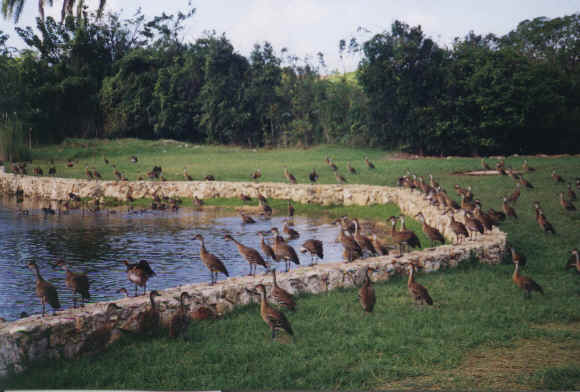
West Indian
Whistling-Ducks,
many places can be hard to see, but not on here at this pool on the Cayman
Islands.
(Photo during FONT Feb. 2001 tour by Susan D'Amico)
Also seen during the FONT 2001 Cayman Islands Tour was a lone duck (actually a drake) certainly rare (more aptly, unheard of) in the Caribbean a male Baikal Teal, among many (hundreds of) Blue-winged Teal. With the Baikal behaving just as were the Blue-winged.
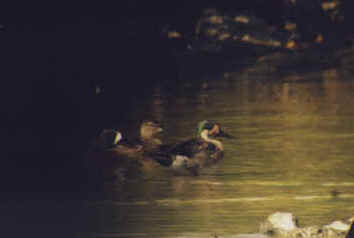
Male Baikal Teal (right)
with male & female Blue-winged Teals
thru a telescope during FONT birding tour
on Little Cayman Island in the Caribbean, Feb. 24, 2001.
(Photo courtesy of Susan D'Amico.)
Not far from the Baikal Teal, on Little Cayman Island (10 miles long and 1 mile wide), and certainly more expected there, were numerous Red-footed Boobies (of both color morphs) and Magnificent Frigatebirds at their breeding colonies. Some males with big red sacs. Elsewhere, White-tailed Tropicbirds were seen (in flight among the seacoast).
Birding in the Caribbean is fun. The FONT Birding Tour Schedule for the region in 2002 is now here in our web-site.
Also in the web-site are complete lists of birds seen during FONT Caribbean tours, cumulatively 342 species.
Ecuador
Birding Tours
February
2001
two consecutive tours:
Andean & Amazonian Birding
Hummingbird & Tanager Birding Tour
During these tours, a
total of 546 species of birds were found, bringing the cumulative total for FONT
tours in Ecuador to 1,101.
The following account written by John Janowski:
Up and down we went during the FONT "Andean & Amazonian"
Ecuadorian Birding Tour in February 2001. Down from the approximately
10,000-foot elevation of Quito, the capital city, to Sacha Lodge in the
Amazonian rainforest. And then back up again to Quito enroute to the Guango
Lodge at 8,000 feet above sea level, followed by San Isidro at about 6,500 feet,
on the east Andean slope, before returning to Quito over the Papallacta Pass at
12,000 feet. At each of these elevations, there was some wonderful birding.
In the center of Quito, at our hotel grounds, we watched Sparkling Violetears
at the flowers in the courtyard. It was only a short walk to the largest park in
Quito, where we saw: Andean Siskin, Southern Yellow-Grosbeak, Vermilion
Flycatcher, and hummingbirds - among them the Black-tailed
Trainbearer was great to see.
Much of our first day was along the old Chiriboga Road, west of Quito. It's a
wonderful birding road, with little traffic. Soaring over the ridges were raptors
including: Carunculated Caracara, and Variable and Plain-breasted
Hawks. Along the roadside, we had very good views of both spinetails, Azara's and
White-browed, and tapaculos that can be
hard-to-see, including: Ash-colored and Blackish. The calls of Chestnut-crowned
and Rufous Antpittas were heard.
At dinner in Quito that evening, we were entertained by a troupe that performed
traditional dances from the various provinces of Ecuador. Especially notable
were the musical instruments, including flutes that date back to the time of the
ancient Incas.
The next morning we were on a flight from the highlands of Quito to the lowlands
of the Amazon. It was breathtaking to fly through the Andes and impressive to
leave the clouds and see an immense rainforest below us. From the frontier town
of Coca, where we landed, we took a 3-hour boat ride on the Napo River to Sacha
Lodge. Along the river there were: Short-tailed Hawk, both Swallow-tailed and Pearl Kites, both
Yellow-headed and Black Caracaras,
and both Turkey and Greater Yellow-headed Vultures.
Where the river was shallow, we weaved between large sandbars with: Cocoi
Herons, both Pied and Southern Lapwings, and both Large-billed and Yellow-billed Terns. There was a single
Black Skimmer, and
even more surprisingly, a single Laughing Gull.
It's hard to single out one particular, best memory from our stay at Sacha.
There were so many good things to remember. Certainly among them were the
numbers of various tropical species of birds, such as: parrots, trogans,
toucans, nunbirds, antbirds, hummingbirds, and tanagers. Of course,
that's why we were there, but really striking, if thought about, would be how we
blended into such a world, even if only for a few days, seeking birds. There was
the darkness of the jungle floor, the dense green foliage of the forest, and an
apparent calmness that added to both our challenge and our experience. Our local
guides were excellent. They taught us how to position ourselves in order to see
birds. And of course the 150-foot high tree tower enabled us to see the area
from another vantage. We could see the canopy-dwellers eye-to-eye. Raptors included
Gray-headed and Plumbeous Kites. Masked Crimson Tanager,
Black-spotted Barbet, and Plum-throated Cotinga were in the trees. (By
the way, taxonomy is fluid, and since this account was written, the Black-spotted
Barbet has become known as the Gilded Barbet, according to
the new field guide "The Birds of Ecuador" by Robert Ridgely.)
Before we left Sacha, our last
morning, we were treated to some excellent sights and sounds, including
those of: 2 Zigzag Herons by us at dawn as we boarded canoes, hundreds of Parrots -
Mealy, Yellow-crowned, and Blue-headed -
congregating at a mineral lick, 3 marmosets scurrying up a thin tree
truck, and spider monkeys with their young moving through trees above
us.
At Coca, we boarded the plane back to the Quito in the High Andes. From there,
we went to a lodge, called Guango, on the upper eastern slope. Enroute, we saw
Black-chested
Buzzard-Eagle, and a couple notable hummingbirds: the Giant,
the largest of all hummers, and the Sword-billed with that
striking long bill.
High in the Andes we saw a Tawny Antpitta, a nice sight. And we birded
stands of polylepis forest, where we saw the Giant Conebill and Stout-billed
Cinclodes, nice sights as well.
The road to the Guango Lodge in the cloud forest was wonderful. It followed a
rushing river with numerous waterfalls. In one set of rapids, there was a family
of Torrent Ducks. At stops along the way, there were flocks of tanagers
and flower-piercers. Overhead, Swallow-tailed Kites at 8,000-feet
seemed a bit out of place. The area is also a wintering locale for Broad-winged
Hawks from North America. They were perched on snags as lively Redstarts
(more properly called Whitestarts), both Spectacled
and Slate-throated, were in the bushes and low trees. Among them, was
even an American Redstart (no white in its tail!) The tanagers were
a colorful tribe indeed, with Flame-faced and Grass-green, bright
indeed.
At Guango, there were, upon our arrival, both a warm meal and a fireplace. And
during our stay, there were some good birds: Bar-bellied Woodpecker and Gray-breasted
Mountain-Toucan, and some spectacular hummingbirds such as Mountain
Velvetbreast and Mountain Avocetbill.
From Guango, we decended the eastern slope of the Andes to a place called San
Isidro, where the good birding continued. Along the trails there, we encountered
a number of mixed flocks, and a some specialty birds: both Golden-headed and Crested Quetzals,
Andean Solitaire, Green-and-Black Fruiteater,
and Long-tailed Sylph. Our nightbirds included: Black-banded and Rufous-banded Owls. Not bad, but even better, were, the next morning: a
thrilling lek of Andean Cock-of-the-Rock near the lodge - one of many
highlights during our tour in Ecuador in February
2001.
Photos from our Ecuadorian Tour in February 2001.
A
list of the birds during the February 2001 FONT birding tours.
A Photo
Gallery of Hummingbirds has been being put into our web-site. In it are some fine photographs
of Ecuadorian
hummingbirds - these photos, which we are appreciative to have, by Larry
O'Meallie, of Louisiana, USA.
A new FONT publication is now available (in 2 volumes) listing "BIRDS &
OTHER WILDLIFE during over 10 Years of FONT Tours in South America". Nearly
2100 species of birds are listed, with information as to where they've been
found in: Argentina, Brazil, Chile, Ecuador, and Venezuela. If you'd like to
receive a copy of the set, please let us know.
Japan
Winter Birding Tours
January-February,
2001
2 Tours:
the first on Honshu & Hokkaido (with a pelagic trip in between), Kyushu,
Amami, and Okinawa,
the second on Honshu & Hokkaido (with a pelagic trip in between), Kyushu,
Amami.
FONT has been
conducting these tours since the early 1990's.
Armas Hill, the FONT tour leader, has been birding in Japan since the early
1980's.
During our annual Japan Winter Birding Tours in 2001 some wonderful birds were seen. Among them were:
A rare Siberian Crane among beautiful White-naped Cranes. 6 species of cranes were seen during the tour. As always, a particularly wonderful experience was being with the Japanese (or Red-crowned) Cranes, dancing, calling, feeding, on the snow in Hokkaido.
An Oriental Stork (a
species that formerly bred, years ago, on Japanese roof-tops) was seen.
Both Steller's Sea-Eagles and White-tailed Eagles were seen closely.
During one day, there were over 50 Steller's Sea-Eagles.
Spectacled Guillemots were seen well just beyond the surf. (That species
is restricted to the region of the Kurile Sea and Hokkaido, Japan.)
Whooper Swans were enjoyed (seen and heard) in the mist on a mostly
frozen lake. Some other brilliant species of waterfowl during the tours were: Baikal
and Falcated Teals, Mandarins and Smews.
During both tours, large and rare Blakiston's Fish-Owls were seen eating fish. Both male and female owls were observed. During the first tour, as the Blakiston's Owl was being seen, a Ural Owl was heard calling nearby. During the second tour, both the Blakiston's and the Ural Owl were seen the same evening.
Other owls during the tour included Long-eared (a number of them on Amami above a road crisscrossed by mice), Short-eared, and the Ryukyu Scops.
Colorful Lidth's Jays were seen well. Amami Woodcock, too. Both of these specialties on the island of Amami.
A Greater Painted-Snipe was flushed from a flooded field on Okinawa. About 20 species of shorebirds (or waders) were seen on that island.
As was the Okinawa (or Pryer's) Woodpecker -possibly the rarest woodpecker in the world. Also on Okinawa: Black-faced Spoonbills (the rarest spoonbill in the world), and Saunder's Gulls (one of the rarest gulls in the world).
Our greatest challenge was the elusive Okinawa Rail (heard, but not seen, by all).
Pelagically,
birds from the ferry between Honshu and Hokkaido included: a number of Laysan
Albatrosses. Also: Short-tailed and Streaked Shearwaters,
Fork-tailed Storm-Petrel, Pomarine jaeger, 8 species of gulls, and 6
species of alcids (among them numerous Least Auklets).
At least 15 whales were seen pelagically during the first tour: 2 Finbacks
(between Honshu & Hokkaido) , and Humpbacks, and Bryde's
Whales (between Amami & Okinawa).
More gulls were
seen from shore during the second tour: on Kyushu with rare Saunder's Gulls others
from mainland Asia: the "Mongolian" Yellow-legged and the "Heuglin's"
Herring. On Honshu: a Thayer's Gull and the "Kamchatka"
Mew or Common Gull.
A seabird that was seen well from shore during the second tour was the Japanese
Murrelet. It was photographed, and is one of nearly 50 species in our
Photo Gallery of Japanese Birds elsewhere in this web-site.
Also here in this web-site, there's itinerary information for upcoming FONT Japanese birding tours, and a cumulative bird-list of all the species found during FONT tours in Japan.
A booklet listing of the 332 species of birds that have been seen during FONT birding tours in Japan is available from FONT. It contains information as where (the islands) and when (the months) the birds have been seen. For a copy, write to FONT at: PO Box 9021, Wilmington, DE 19809 USA, or call in the USA: 1-800-362-0869, elsewhere 1-302-529-1876.
New
Zealand Birding Tour
November-December 2000
The FONT New Zealand birding
tour in 2000 was a great success and the local leaders (Caren Shrubshall &
Mark Hanger) were excellent.
Almost the entire bird-list
(of a total of 124 species seen) consisted of 'star' species.
There were three species of penguins (two of them rare endemics).
There were some excellent pelagic trips which
produced five species of albatross and a host of other exciting seabirds.
The rare, unique Blue Duck was seen on a mountain stream in the
spectacular scenery of Fjordland.
There was a fine assortment of shorebirds (or waders), including
good numbers of the delightful endemic Wrybill and the endangered Black
Stilt.
There were wonderfully entertaining and superbly confiding Kea parrots,
and a host of very special passerines (like the endemic Rifleman and
the Tui).
The following account written by the FONT tour leader, John Janowski:
2000 was our 10th year for this tour, during a prime time for bird migration along the West Coast. Over the years, an avian rarity or two has been present at the time of the tour along with the more regular migrants.
At the beginning of our Sept 2000 tour, in Washington State, we viewed, at close range, 3 Bar-tailed Godwits among a large flock of Marbled Godwits. The full-day pelagic trip from Westport, Washington has always been productive for us, and was again this time. This is one of the most reliable of trips for the Fork-tailed Storm-Petrel. In addition to numerous seabirds, and some marine mammals, if the weather's clear, there's a fine natural setting of the distant mountains of the Olympic Peninsula as we're returning to shore.
There's yet more beautiful scenery, and even more good birds, during this tour, in the area of the Puget Sound. Our trip to Vancouver Island, Canada, by ferry, through the San Juan Islands provided fine views of seabirds and marine mammals. Among the seabirds, the Marbled Murrelet. On land, we saw 5 Skylarks on Vancouver Island. In the city of Vancouver, we saw another bird species introduced into North America years ago (and one that has been declining recently), the Crested Myna. Along the coast, in that area, we saw a Eurasian shorebird, the Ruff.
In the Cascade Mountains of Washington, we enjoyed a family of Gray Jays and 5 Varied Thrushes, on the wetter western slope. On the drier eastern slope, we enjoyed (as much, maybe more) a Ruffed Grouse and 5 Blue Grouse. This was our best PC tour for grouse. Red-naped Sapsuckers were again, as during other years, nice to see. A sighting rather unusual for us was a close view of a Porcupine sleeping in a tree.
During the second portion of the tour, in California, we had an excellent look at a pair of Golden Eagles. And we saw both Clark's and Western Grebes at one place, and all 3 of the North American goldfinches. There was a total of 7 White-tailed Kites, with two of them in an aerial display. An Ash-throated Flycatcher was seen in a river valley. In all, 207 species of birds were found during our September 2000 Pacific Coast tour, bringing the cumulative bird-list for the tour, over 10 years, to 320 species.
The cumulative
list of birds and mammals is in this web-site, along with the itinerary
for the Pacific Coast tour in September 2001.
John Janowski, who has led this tour the last few years, and will again in 2001.
In the past, Mr. BJ Rose has also done a fine job of leading this tour. Armas Hill led the first PC birding tour in 1991. Rare birds that have been seen during this tour, over the years, have included: Red-tailed Tropicbird (once, during the pelagic trip we do annually out of Monterey, California), Mongolian Plover (now called Lesser Sandplover), Little Curlew, Long-toed Stint, and White-winged Tern. In 1998, we saw the Xantu's Hummingbird that was visiting a feeder in British Columbia. That same year we saw Xantu's Murrelet out of Monterey - making it a 2-Xantus Tour! Visit our Photo Gallery of North American birds.